

Knowledge on export of Chinese brand construction machinery under SKD model
Exporting construction machinery under the SKD model is a key step for Chinese construction machinery companies to upgrade from “product exports” to “brand and production capacity exports.”
I. What is SKD? How does it differ from CKD and complete machine exports?
First, let’s clarify a few key concepts:
· Complete machine export: All production, assembly, and testing are completed in a Chinese factory, and the finished equipment is shipped directly to overseas customers. This is the most traditional and simplest model.
· SKD: Semi-knocked-down (SKD) – This model involves disassembling the equipment into several large assemblies or modules, such as the chassis, engine, cab, and working equipment (bucket, boom), and then packaging them separately before shipping to the destination country. Local factories or partners then perform simple bolting and assembly, followed by testing and painting.
· CKD: Completely knocked-down (CKD) – This model involves a higher degree of disassembly, with nearly all components packaged and exported as individual parts. Nearly all assembly processes are completed locally, essentially building an overseas assembly line in China.
Core difference:
Disassembly degree: whole machine export < SKD < CKD
Localization degree: whole machine export < SKD < CKD
For Chinese construction machinery brands, SKD is currently the most mainstream and practical localization model
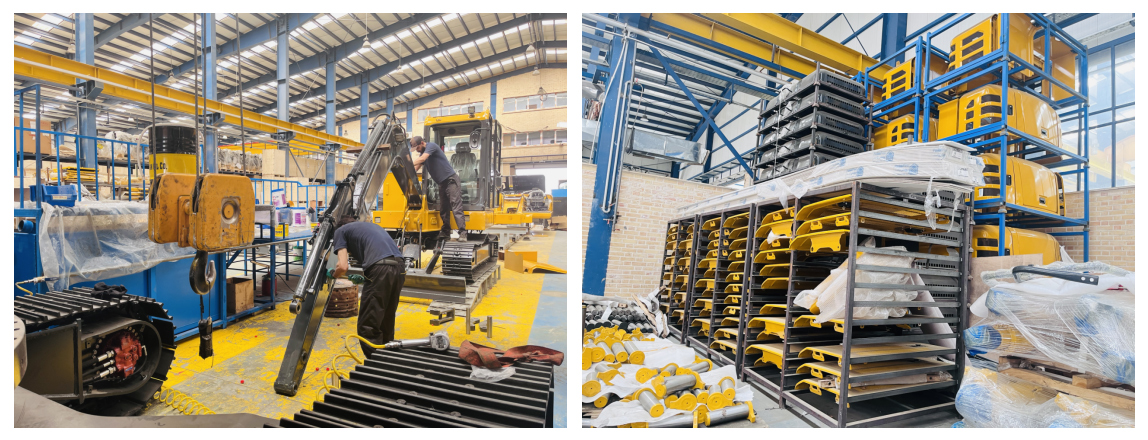
Why do Chinese brands choose the SKD (Sknitted Goods) model for export?
The advantages of the SKD model are strategic, primarily reflected in the following aspects:
1. Avoiding High Tariffs and Trade Barriers
· Many developing countries impose high tariffs (as high as 20%-40%) on imported complete machines to protect their industries or increase fiscal revenue, but tariffs on “components” are much lower. Importing SKD as “semi-finished products” or “components” significantly reduces the tax costs of the final product, thereby ensuring price competitiveness in the end market.
2. Reducing Logistics Costs
· Complete machines take up a lot of space and have irregular shapes, resulting in high logistics costs. Disassembling equipment into modules allows for more efficient use of container space, significantly reducing the average ocean freight cost per unit.
3. Meeting Local Content Requirements
· Many countries (such as Brazil, India, Russia, and many Belt and Road Initiative countries) have policies requiring government procurement or certain large-scale projects to use products that meet a certain local content ratio. SKD assembly is considered local manufacturing, which can help Chinese brands gain market access.
4. Rapid Market Responsiveness and Cost Reduction
· Establishing assembly plants in target markets allows for better customized production based on local needs (such as varying emission standards and configurations) and shortens delivery cycles. Furthermore, local sourcing of some low-value components (such as tires, batteries, and hoses) can further reduce costs.
5. Enhanced Brand Image and After-Sales Service
· Labels such as “Locally Assembled” or “Locally Made” can enhance local brand recognition and trust. Furthermore, assembly centers often also serve as parts warehouses and repair service centers, significantly improving after-sales response and boosting customer satisfaction.
6. Diversified Supply Chain Risk
· Moving final assembly overseas can mitigate the direct impact of international political and trade frictions on finished product exports.